
The Hallway That Has a Point of View
The hallway is the room that most people forget to design. It is transitional by nature, a space you move through rather than occupy; and so it tends to get the leftover decisions: a mirror, a coat hook, a console table from somewhere else. The result is a home that announces itself beautifully from the outside and then immediately undersells the rest of the experience the moment you open the door.
This hallway makes the opposite argument. It understands something that the best interior designers know instinctively: the first room sets the tone for everything that follows. And it delivers a tone that is, without qualification, exactly right.
The stair runner: the decision that changes everything
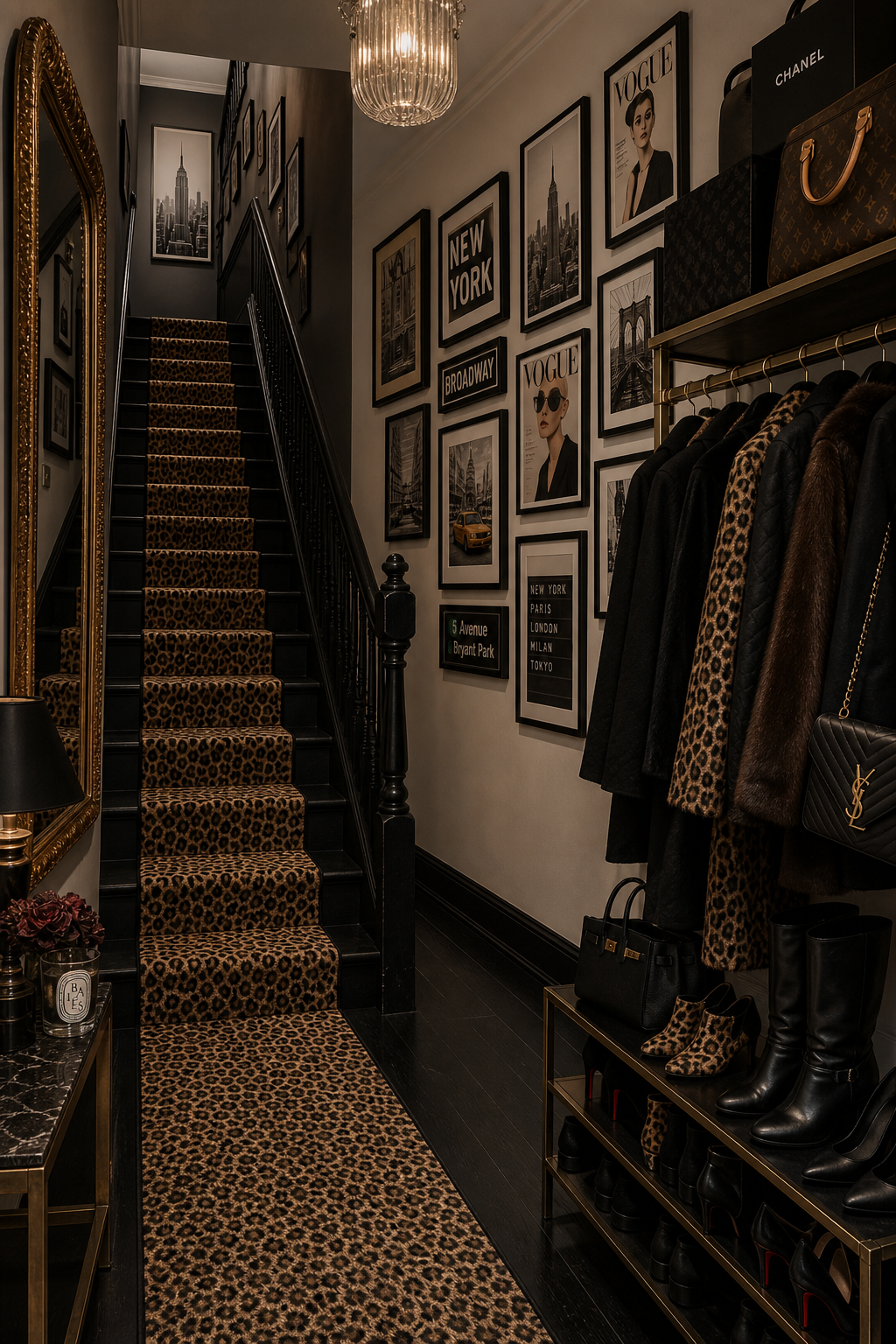
A leopard print stair runner is the single boldest choice in this space and the one that earns every other detail its place. It runs the full length of the staircase against a black painted stair base, and the effect is immediately cinematic — a visual escalator that draws the eye upward and gives the narrow space a sense of drama it would otherwise never achieve.
It also does something more subtle. By introducing the leopard print here, at the architectural centre of the space, it makes every other element — the gallery wall, the clothing rail, the accessories — feel like a natural extension of the room's palette rather than separate decorating decisions. The runner is the foundation. Everything else is built on top of it.
Oh hey, do you wish you could go clothes shopping and never feel guilty about it later? If that's you, click here and get the solution.
-
Oh hey, do you wish you could go clothes shopping and never feel guilty about it later? If that's you, click here and get the solution. -
The gallery wall: curation with a narrative
The art wall is where this space reveals its point of view most explicitly, and it is a very specific one. New York — its skyline, its subway signage, its fashion mythology — is the subject, assembled with enough variety in frame size and content to feel collected rather than bought as a set. Vogue covers sit alongside Brooklyn Bridge photography. A Broadway sign hangs next to a yellow cab shot. The "New York, Paris, London, Milan, Tokyo" text piece positions the hallway squarely in the world of fashion capitals.
The framing is consistent — all black, all relatively slim — which is what separates a gallery wall from a collection of pictures. Consistent framing imposes order on varied content and makes the whole read as intentional. The mix of photography, typography and editorial imagery gives it the feel of a fashion magazine's mood board, which is, for LustreList, exactly the reference it should be making.
The rail: where fashion becomes the décor
A brass clothing rail displaying a leopard coat, a fur, and a structured black jacket alongside an YSL chain bag is the detail that most people would hesitate to include and that makes the space genuinely memorable. It positions the hallway as a dressing space — an antechamber to a wardrobe rather than simply a passage to the stairs — and it treats fashion as interior design, which it always has been in the right hands.
The shoe shelf below, with visible Louboutin red soles, a structured tote and leather ankle boots, continues the logic. Accessories on display rather than hidden in storage is an editorial choice — it says these things are worth looking at, which of course they are.
The finishing details
The gilt-framed mirror leaning against the left wall introduces the one warm metallic note in a scheme that is otherwise all black, brass and leopard — a softness that prevents the narrow space from feeling too severe. The black lamp with a Diptyque candle on the console table keeps the palette consistent right down to the smallest element.
The ribbed glass pendant overhead provides clean, downward light without interrupting the gallery wall with an oversized fitting. It is a restrained choice in a room that is otherwise committed to excess, and it is exactly the right one.
The lesson
A hallway is not dead space. It is the first and last room every guest experiences, and the one that sets the expectation for everything in between. This one sets an expectation of someone who has thought carefully about beauty — who understands that leopard print is a neutral, that fashion is decoration, and that a considered space does not require a large footprint. It requires only intention, applied all the way through.
From the runner to the rail, this hallway has it.